On-pack labelling overview
The On-pack labelling module answers a designer's question: what must this pack actually carry, in this market, before it goes to print? It has two halves - a requirements explorer that lists every cited on-pack element a market requires, and an artwork check that reads your artwork and compares it, element by element, against those requirements.
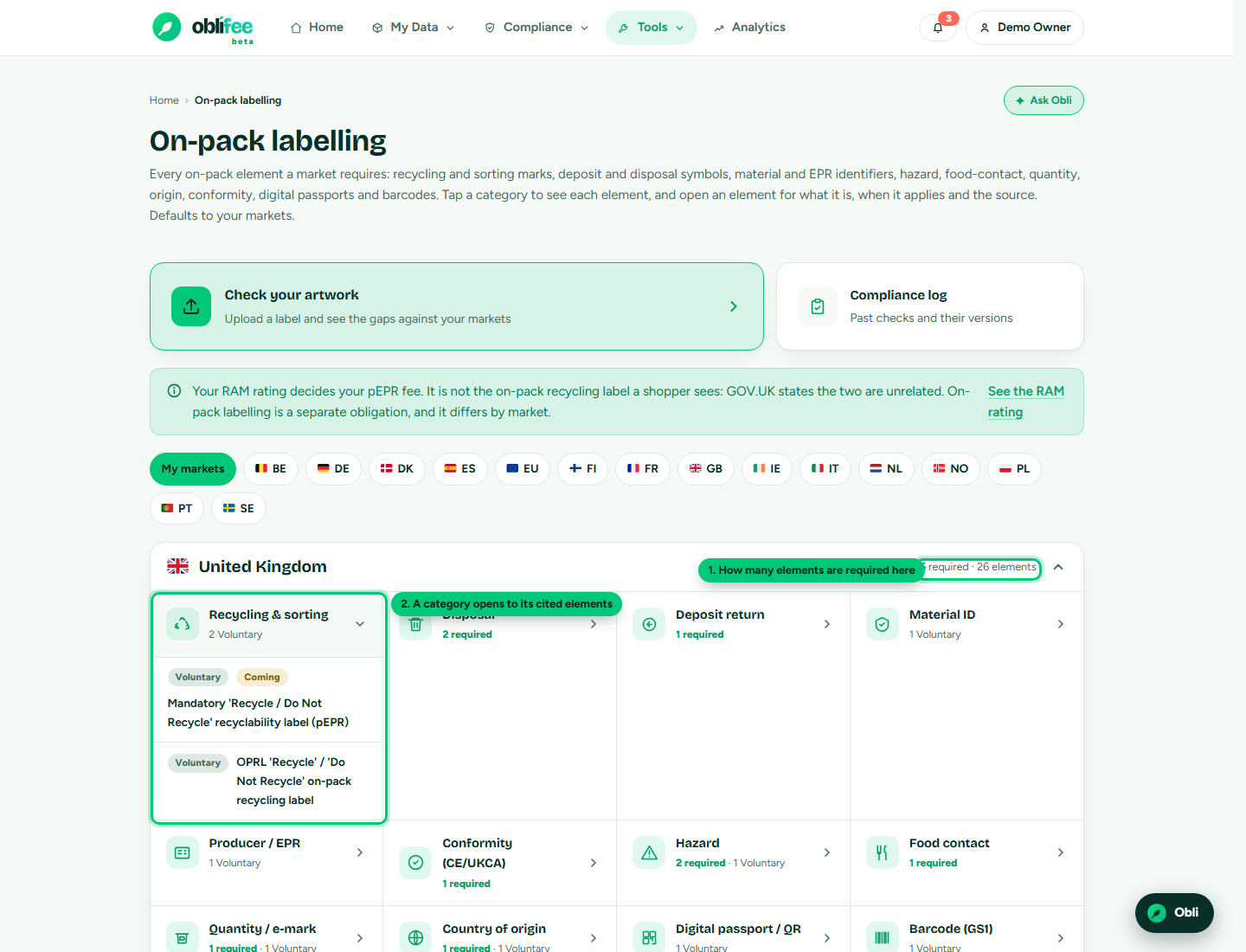
What it checks
The explorer groups a market's requirements into categories, each a familiar family of on-pack marks and information:
| Category | Examples |
|---|---|
| Recycling & sorting | OPRL Recycle, Triman, Info-tri, the Mobius loop |
| Material ID | Resin codes 1-7 in a triangle, PAP 21, PET, HDPE |
| Producer / EPR | Green Dot, producer-responsibility marks |
| Disposal | Crossed-out wheelie bin, Tidyman |
| Deposit return | A deposit logo with a value |
| Hazard | Red-diamond GHS/CLP pictograms |
| Food contact | The glass-and-fork symbol |
| Quantity / e-mark | Net quantity and the estimated (℮) sign |
| Country of origin | "Made in …", "Product of …" |
| Digital passport / QR | QR or data-matrix codes |
| Barcode | EAN / GTIN retail barcode |
| Conformity | CE or UKCA marks |
| Product identity & dates | Name, net quantity, dates, storage, address, batch/lot |
| Ingredients / allergens / nutrition | Ingredient and INCI lists, emphasised allergens, nutrition tables |
| Language | The language(s) the mandatory text must appear in |
Every element in the explorer is a cited fact, and each carries:
- whether it is mandatory or voluntary;
- its status - active now, upcoming, or proposed;
- a plain-language summary of the requirement;
- what it applies to (for example, only food, or only cosmetics);
- the legal reference and citations to the source.
:::info EU rules apply on top of national ones For an EU or EEA market, the check evaluates that nation's own rules plus the EU-wide rules that bind every member state, de-duplicated so a country-specific rule wins where the two overlap. :::
Why it matters before sign-off
A missing or wrong on-pack mark is expensive precisely when it is hardest to fix - after artwork is approved and plates are cut. Checking labelling early means you:
- catch a missing mandatory mark (a recycling label, an EPR identifier, an allergen emphasis) while the artwork is still editable;
- see what is coming - upcoming or proposed rules - so a print run does not go out already out of date;
- confirm the pack carries the right language(s) for each market it ships to.
:::note Labelling is not the recyclability fee The on-pack recycling mark a consumer reads is a different thing from the RAM recyclability rating that modulates your fee. This module covers the marks; RAM covers the rating. :::
Where to go next
- Running a labelling check - check your artwork against a market.
- Uploading artwork - how to add and manage artwork images.
- The compliance view - every check you have run, in one log.