Core concepts
Everything you do in Oblifee sits on a small set of ideas. Learn them once and the rest of the product reads naturally: you enter your data against these objects, and every module reads the same data to answer a different compliance question. This page is the conceptual backbone - keep it handy while you set up.
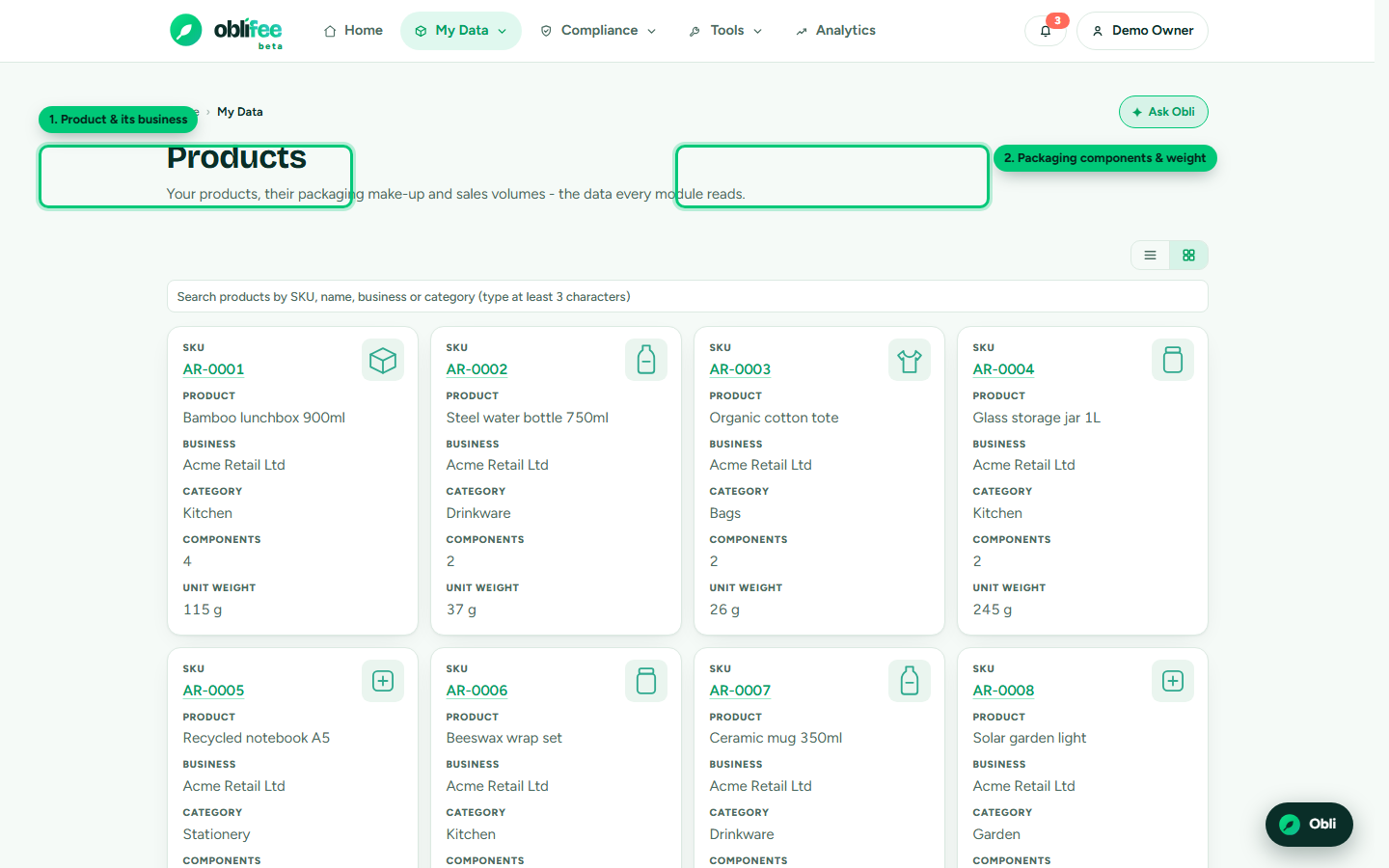
The objects, top to bottom
| Concept | What it is | Where you manage it |
|---|---|---|
| Workspace (tenant) | Your isolated environment. All your data lives inside it and is never shared with another workspace. | You are always inside one; switch if you belong to several. |
| Business | A legal entity that places goods on the market - its addresses, contacts and the person responsible for compliance. | Businesses |
| Brand | A trading brand. Brands are separate from businesses because one brand can span several of them. | Brands |
| Product | Something you sell, belonging to one business and optionally one brand. | Products (My data) |
| Packaging | How a product is packed: individual components (material + weight) and named outer pack types, grouped per pack. | The product page |
| Volume | How much of a product you placed on a market in a period. The quantity that drives fees and thresholds. | Volumes (My data) |
| Market | A nation or region where you have obligations. Each market has its own rules in the brain. | Markets (Compliance) |
| Module | A switchable capability - EPR, recyclability, labelling, WEEE, reporting, consultant workbench. | Enabled per workspace |
| Regulatory brain | Oblifee's continuously monitored dataset of rules, fees, thresholds and guidance, with citations. | Read-only, behind every figure |
| Confidence label | Every regulatory figure is tagged confirmed, illustrative or estimate. | Shown next to figures |
How they relate
Read it as: a workspace holds businesses and brands; each business owns products; a product is built from packaging components and pack types, is placed into markets as monthly volumes, and may carry a brand. The regulatory brain supplies the cited rules for each market. The modules you have enabled read all of this to produce your position.
Workspace (tenant)
Your workspace is the boundary around everything you own. Products, volumes, businesses, brands, team members and settings all belong to exactly one workspace and are invisible to any other. A person can belong to more than one workspace (an agency looking after several clients, say) and switch between them - see Switching workspaces.
:::info Isolation is enforced, not assumed Separation between workspaces is enforced in the database on every request, not just hidden in the interface. See Security & trust. :::
Business
A business is a legal entity - the company that actually places packaging on the market and carries the obligation. It holds its registered and operating addresses, its legal-entity name and company number, its home country and currency, its sales channels (B2B, direct-to-consumer or both), and its key contacts - including the one person marked as responsible for regulatory compliance.
You can hold several businesses in one workspace. Group companies, separate trading entities and acquisitions each register and report in their own right, so Oblifee keeps them distinct while letting you work across all of them at once. Full detail is on the Businesses page.
Brand
A brand is a trading identity. It is deliberately separate from a business because a single brand can be sold through more than one legal entity, and one legal entity can own several brands. A brand records its own name, legal entity, registered address, known on-pack marks and notes, and is linked to the businesses it applies to. Products are then assigned to a brand. See Brands.
Product
A product is a single sellable item. It belongs to one business, may be assigned to one brand, and carries a SKU, a name and a category. On its own a product is just a label - its compliance weight comes from the packaging and volume attached to it.
Packaging: components and pack types
Packaging is where the numbers come from. Two ideas work together:
- A component is one material in one part of the pack - for example 18 g of PET in the bottle, or 2 g of aluminium in the closure. Each component records its material code, its weight in grams, whether it is recyclable, and which packaging layer it belongs to: primary (touches the product), secondary (retail/grouping) or transit (shipping).
- A pack type is a named outer packaging unit - a case, a mailer, a pallet set - with how many units it holds and which channel it applies to. Components can be attached to a pack type so the per-unit maths stays correct.
Together these describe exactly what material, and how much of it, each product puts on the market. That is the raw material the EPR, recyclability and reporting modules all consume.
Volume
A volume is a quantity placed on one market in one period (typically a month), for one product. Volumes are what turn packaging into money and thresholds: multiply a product's packaging weight by the quantity placed and you have the tonnage a regulator asks about. You can enter volumes by hand, import them from a spreadsheet, or have them flow in from a connected storefront or ERP.
Market
A market is a nation or region where you have obligations - identified by a country code (and sometimes a sub-region). Oblifee detects your markets from the volumes you place, and each market brings its own set of rules from the brain: fee schedules, material categories, registration thresholds and labelling requirements.
Module
Oblifee is modular. EPR is the base every workspace has; the other capabilities - recyclability (RAM), on-pack labelling, WEEE & batteries, reporting & PPWR, the design studio and the consultant workbench - layer on top of the same data. All read the same products, packaging, volumes and markets, so you enter something once and every enabled module can use it. See Compliance modules.
The regulatory brain
The regulatory brain is Oblifee's continuously monitored dataset of rules - fees, thresholds, obligations, registration paths, labelling requirements and regulatory news. It is refreshed on a daily cycle and sits behind every figure the product shows, carrying a citation to the source for each fact. You never edit the brain; you read what it says about your markets. See The regulatory brain.
Confidence labels
Because rules move and sources vary in certainty, every regulatory figure carries a confidence label:
| Label | Meaning |
|---|---|
| Confirmed | Backed by a current, cited official source. |
| Illustrative | A worked figure based on published rules, shown to give shape - treat as guidance, not a final number. |
| Estimate | A modelled or inferred value where the source is incomplete. |
These labels appear next to numbers throughout the product so you always know how much to lean on a figure. See Confidence & citations.
Where to go next
- Quick start - put these concepts to work end to end.
- Your workspace - manage businesses, brands and team.
- Compliance modules - what each module does with this data.
- The regulatory brain - where the rules come from.